Contains affiliate links. All opinions are honest, as always.

If you’re like me, you’ll be careful of what you put on your skin, and what you eat, going organic, and avoiding toxins and microplastics whenever you can. But have you given much though to the nasties that could be lurking in your tap water? I’ve been meaning to get a water filter for ages. We’ve had a few over the years that haven’t been great, and now there are so many to choose from, I got overwhelmed and stopped looking. Under-sink, plastic jug, tap water filter, what is best? Well I decided on a tap water filter from FlowPure®. Keep reading for my honest review of the FlowPure® Pro Tap Filter, and a 10% discount code.
The Pros and Cons of Different Water Filters
The water here in the UK is OK to drink. But it’s still not great. And we live in a hard water area too. I tried an under-sink water filter before but it was difficult to fit and took up quite a bit of cupboard space. And then it started leaking. So that was not great.
I thought the gravity countertop water filters look good, but again: so much space! We don’t have a lot of counter space, so that was a no for us.
I didn’t want to use a plastic jug filter, for a few reasons: they don’t look great, during summer you’d need to store them in the fridge (again, no space in there!) the cartridges need replacing so often, and are made of plastic, and the jug itself is plastic. So, for a household that is trying to avoid using plastics, a plastic jug that stores water is a no-no!
So that left the kind of water filters that screw onto the tap. But which is the best one?
Why I Chose FlowPure® Tap Water Filter
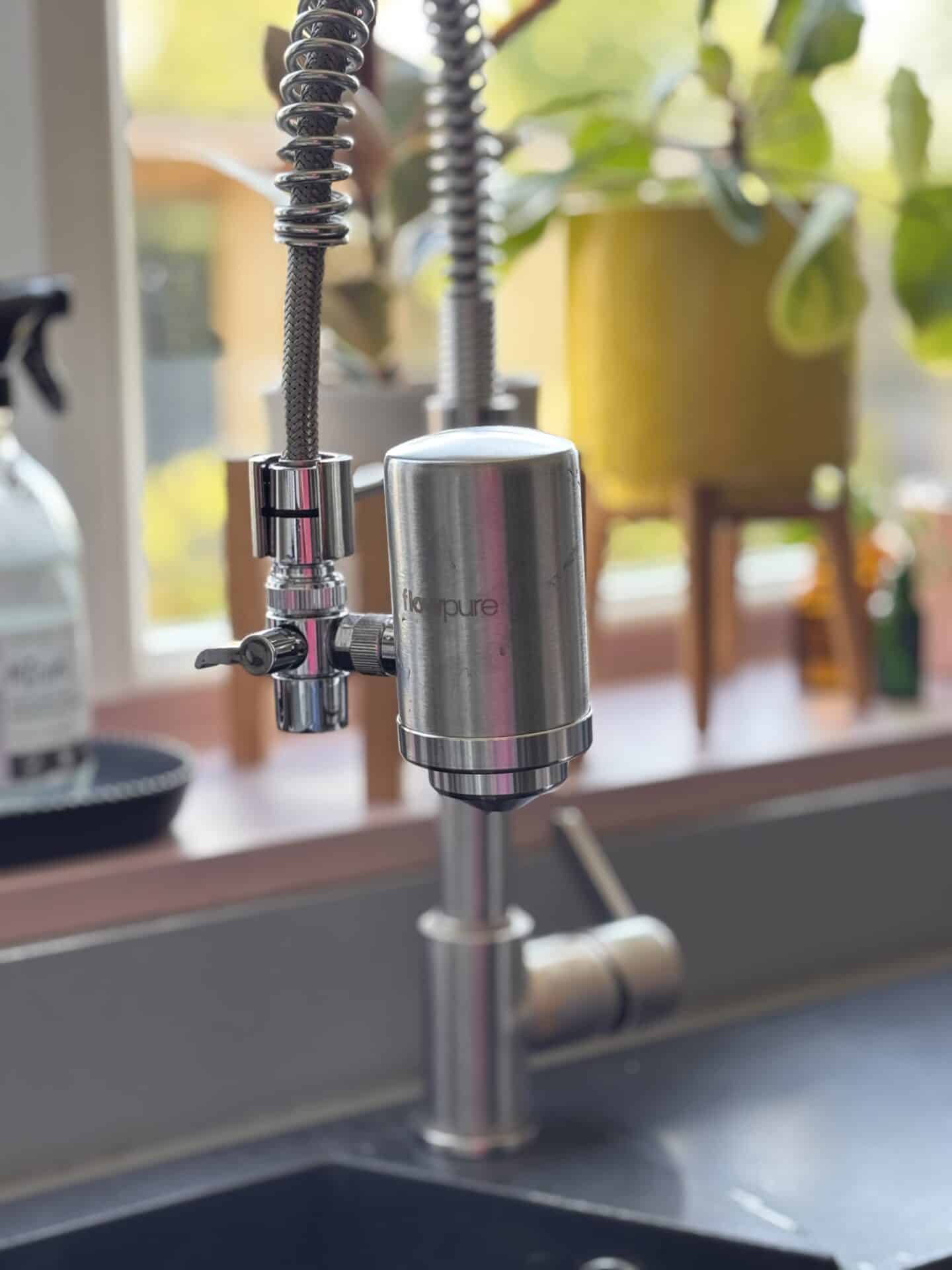
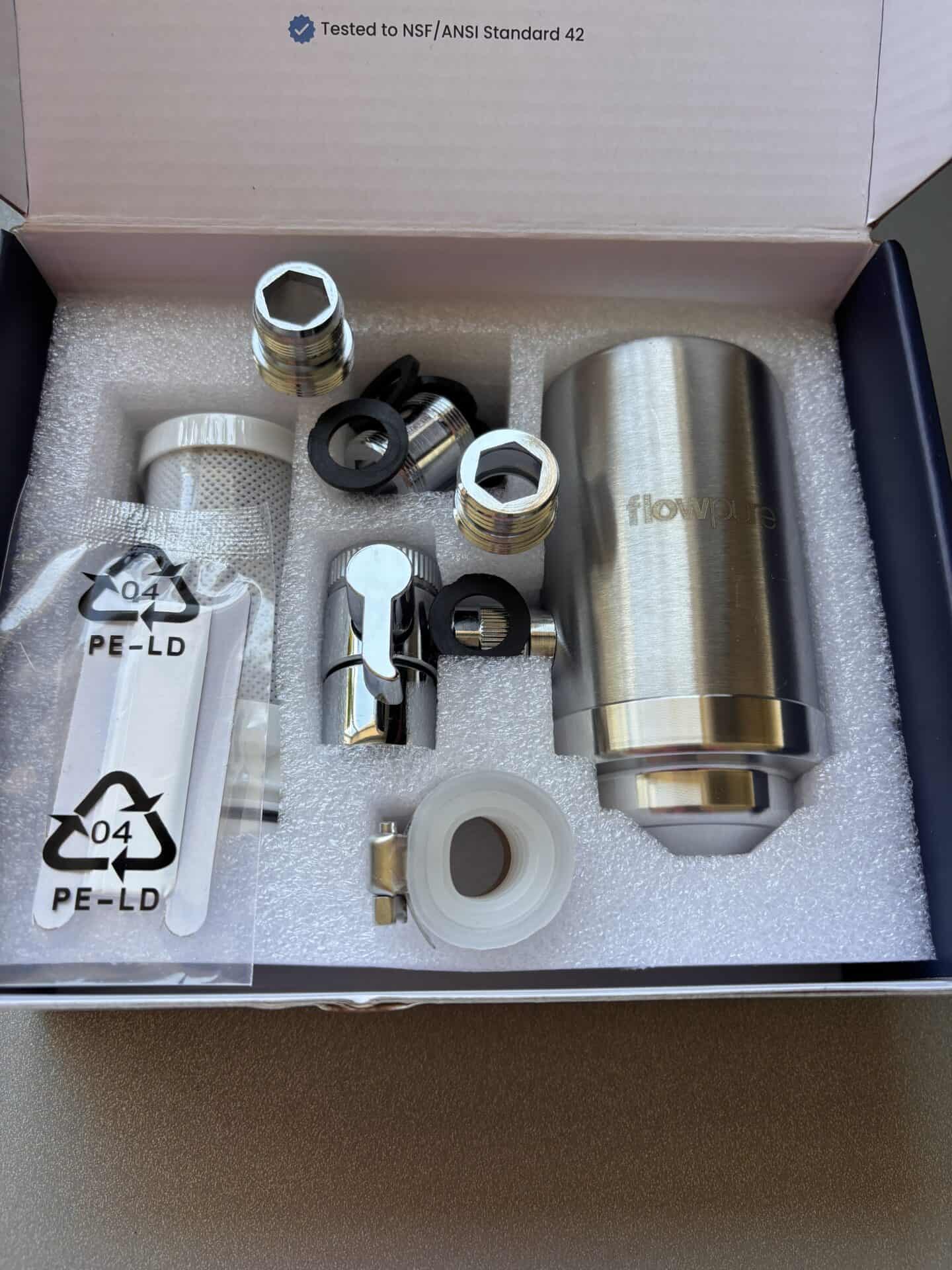
For me, the best tap water filter is the one that looks good, filters well, and is the most affordable. That turned out to be the stainless steel FlowPure® Pro Tap Filter. You get the filter unit, two filters, and all the fixings and fittings for most kitchen taps for £39.99.
It has a 304 brushed stainless steel body, is pretty easy to fit (my tap is not optimal for fitting, which I expected thanks to advice from them) and it lets me easily switch from filtered to non-filtered water.
How To Fit the Tap Water Filter
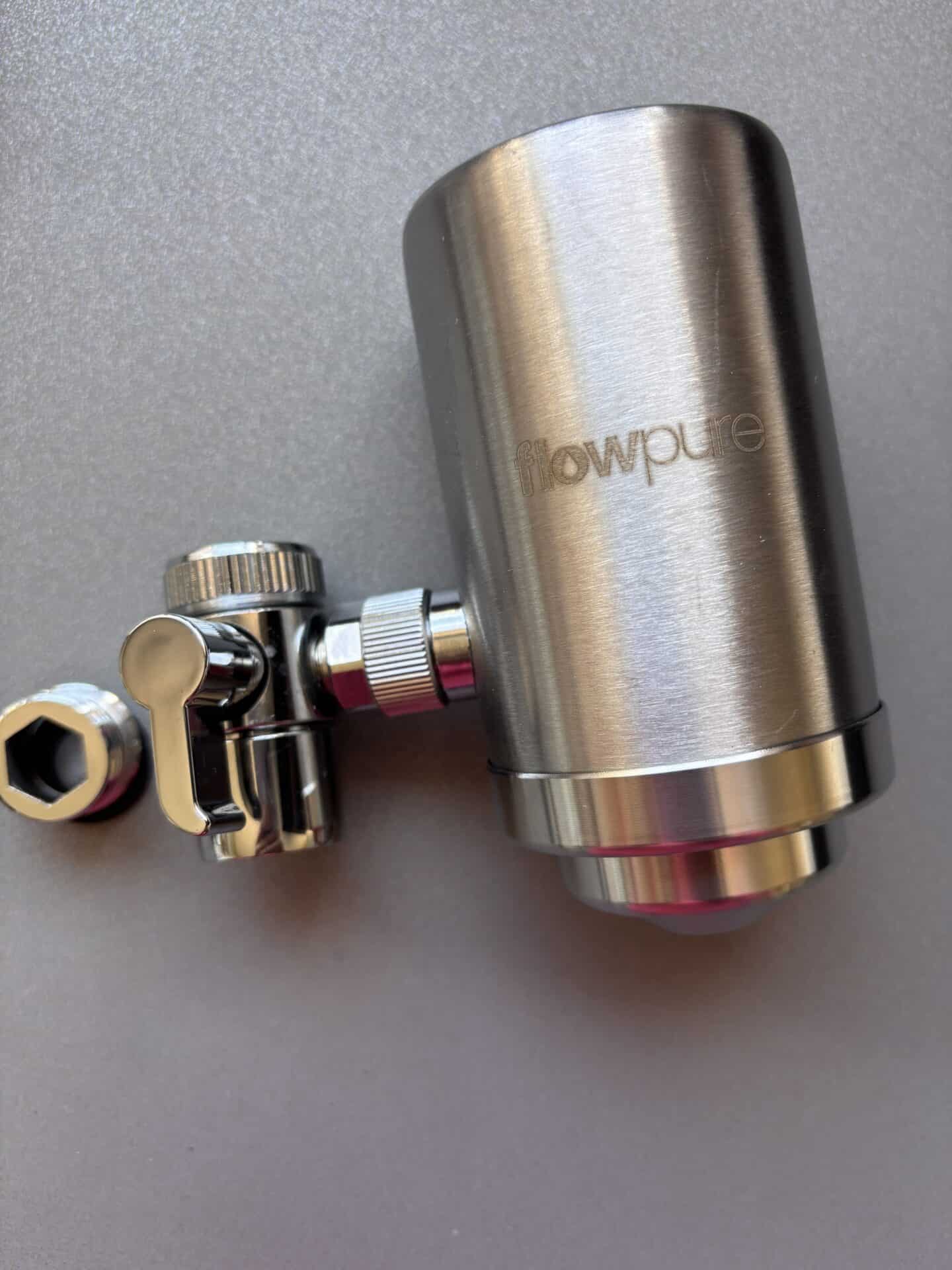
The bottom of the filter unit unscrews, and you just screw the filter in, and attach to your tap. The kit comes with lots of different fittings to fit any tap so I found a process of elimination worked best; I tried them until I found the best fit. Then the whole thing just screws onto your tap. You filp the lever to divert it from normal water to filtered water.
Once it’s fitted, you can easily unscrew it if you need to, but you can easily change the filter with it still attached to the tap.
I also bought a swivel adapter that attaches to the unfiltered water part of the tap, which helps when cleaning the sink and rinsing dishes. As you can see, the unit is a little on the heavy side for my tap. It sags down every now and them, and we need to push it back up into the bracket. But like I said, I knew this was a risk when I ordered it, as I have an unusual tap!
You just twist the extra attachment to turn it from a normal stream into a spray stream.

The Benefits of the FlowPure® Tap Water Filter
So now you know why I like the filter, let’s talk about why it can be beneficial to filter your tap water. FlowPure say filtering our water is 96% cheaper than buying bottled water (and obviously there is an enormous environmental cost in terms of single-use plastic waste for bottled water too). It has 2,000 x finer filtration than a standard jug filter, and it reduces up to 150 contaminants.
How Safe is My Tap Water?
I tried their online tool to see what contaminants may be in the water in my area. It scores 63/100 on their own scale, and using their filter takes it to 91/100. I do take these kinds of tools with a pinch of salt so please do your own research.
They say there are 6 contaminants worth filtering: chlorine, lead, nitrates, chloramine, microplastics, and limescale. It’s very important to point out that straight from the tap, these are all within the legal limits, where they exist. (There are no legal limits for microplastics or limescale) Even so, that doesn’t mean I want to consume more than I have to. So where does all this come from?
- Chlorine is added by the water company to banish bacteria so it definitely has a purpose. It doesn’t taste great at all but is not thought to be dangerous, at least not in the levels found in tap water. But once it’s done its job it can be filtered out through activated carbon filtration.
- Lead is normally from old lead pipework, and is known to be a cumulative poison – lead based paint was banned for a very good reason! Flow Pure say that boiling doesn’t remove lead and may even concentrate it slightly, so now I know that, I’ll filter my cooking water too!
- Nitrates come mainly from agricultural run-off. Again lead can be concentrated in boiled water so if you’re using it to make baby formula, this is a concern.
- Chloramine is a longer-lasting disinfectant that can come from water treatment.
- Microplastics are tiny plastic fragments that enter the supply from our environment. Long-term effects are still being studied but they’ve been found in placentas and lung tissue.
- Limescale comes from the calcium and magnesium in limestone (if you need to descale your kettle on the regular, you likely have hard water) It’s not dangerous but who wants those horrid floating bits of limescale in your cuppa? Yuk. It can make skin feel tight and dry too.
How This Tap Water Filter Works
The filter has several layers, designed to filter different contaminants from the tap water. For example, activated charcoal filters chlorine and chloramine taste and smell, and pesticides and VOCs. The fine sediment stage filters microplastics. Ion exchange and carbon filters reduce heavy metals like lead. And the 0.1 micron ultrafiltration layer reduces bacteria and parasite cysts. I am too scared to Google ‘parasite cysts’, but I’m happy to know this tap filter helps reduce them! This tap filter system has been independently tested and you can read more on the FlowPure website.
Can You Recycle the Filters?
I asked their helpline about this, and yes, you can. You have to send them back to the company at your own expense, but I plan to save them up until I have a few. We use one filter every 3 months, so will use 4 a year.
The Water Taste Test
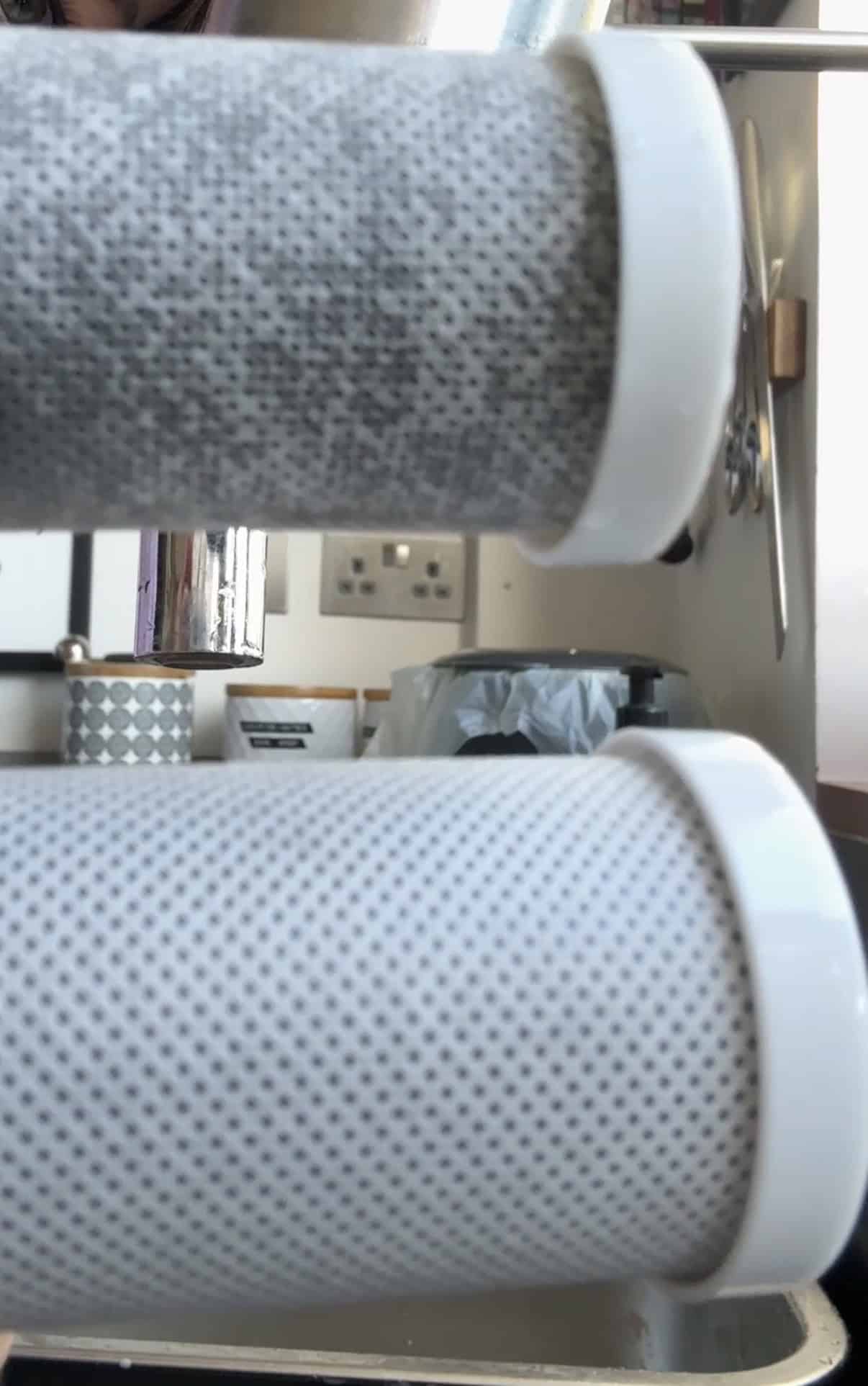
So, can we tell the difference between filtered and unfiltered water? The short answer is yes. It tastes better, and it also smells much better. When you smell them both, the unfiltered water has a slight chlorine smell which is not present in the filtered water. I’ve also noticed that I am not having to descale the kettle as frequently.
This photo shows how the filter looks when it’s been used for 3 months, versus the new filter I was swapping it with. Kind of eye opening, right?
Where to Buy The Best Tap Water Filter (and save 10%)
You can buy your own FlowPure Pro Tap Filter kit, which comes with two filters included (one is inside the stainless steel unit) and a wide variety of fittings for £39.99. Add the code PINKSCHARMING to save 10%.